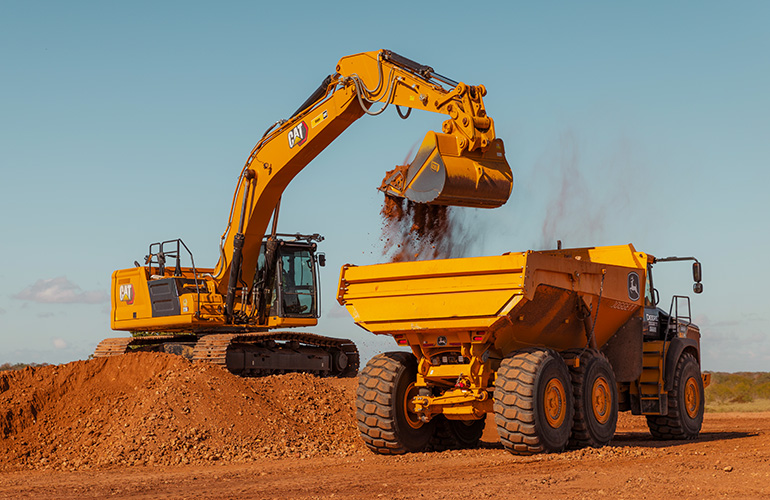
In 2025, Bedrock Robotics made headlines by deploying autonomous heavy-machinery — specifically excavators — on real, active construction sites. Robotics & Automation News+2PR Newswire+2
- Their systems have already moved over 65,000 cubic yards of earth while loading dump trucks, using the same workflow that human operators would use. PR Newswire+1
- The deployments aren’t limited to small-scale tests: Bedrock’s autonomous excavators are being used for large-scale projects — for example, preparing a 130-acre manufacturing facility site in partnership with a major contractor. Robotics & Automation News+1
- The conversion to autonomy covers a broad range of heavy equipment — from standard excavators (20-ton class) to large 80-ton machines — showing flexibility across equipment sizes. PR Newswire+1
This marks a pivotal shift: heavy-machinery automation isn’t a lab experiment anymore. It’s real, in-the-field, and yielding tangible results.
🔧 How Bedrock Does It — Retrofit, Not Replace
One of the most interesting aspects of Bedrock Robotics is how they approach automation — they retrofit existing heavy machinery rather than building new, custom robots from scratch. Bedrock Robotics+2intelligentbuild.tech+2
- The retrofit involves “same-day installations” of sensors, compute hardware, and autonomy software. Bedrock Robotics+2roboticstomorrow.com+2
- This flexibility means contractors don’t have to buy new machines; they can convert their current fleet. For many, that makes adoption far more economically feasible than replacing entire fleets. Robotics & Automation News+1
- Behind the scenes, the autonomy infrastructure uses machine-learning and data-driven systems — benefiting from the founders’ background in self-driving vehicles and autonomy at the scale of public roads. MCJ+2Bedrock Robotics+2
In summary: Bedrock aims not to disrupt existing industry hardware completely, but to upgrade — making heavy equipment “autonomy-ready” even if it originally was fully manual. That’s a pragmatic and scalable route toward mass adoption.
✅ Why This Matters — What Problems It Solves
• Tackling Labor Shortage & Workforce Challenges
- The construction industry — especially heavy civil projects, large-scale digs, and infrastructure builds — often suffers from a lack of skilled operators. With many projects stuck waiting for manpower, automation helps fill that gap. Bedrock’s CEO explicitly mentions that their solution helps “bridge the gap” between rising demand and dwindling operator availability. intelligentbuild.tech+1
- For tasks like repetitive excavation — scooping, loading, dumping — human operators often get bored or burnt out. Autonomous machines can handle repetitive heavy-work tirelessly, freeing human labor for more specialized or supervisory roles. PR Newswire+2Robotics & Automation News+2
• Speed, Efficiency & 24/7 Capabilities
- Autonomous machines don’t need breaks — they can operate longer hours, which can greatly accelerate project timelines, especially for massive earth-moving or site-preparation jobs. intelligentbuild.tech+1
- Retrofitted autonomy provides flexibility: machines can switch between manual and autonomous modes depending on project needs or regulatory requirements. This versatility is key for real-world adoption. Robotics & Automation News+2Bedrock Robotics+2
• Safety and Predictability
- Heavy-machinery operations are among the most dangerous construction tasks. Autonomous systems can reduce risk by relying on consistent, data-driven operation rather than human fatigue or error. Bedrock emphasizes this as part of their value proposition. MCJ+2PR Newswire+2
- Automation can also enable better monitoring, remote supervision, and real-time data tracking — helping managers plan more precisely and catch issues early. intelligentbuild.tech+1
🏗️ Challenges & What’s Still to Be Proven
Of course — this transition isn’t without its hurdles. Some open questions and potential barriers:
- Generalization across diverse job sites: Construction sites vary wildly — different terrain, weather, soil types, and unexpected obstacles. While Bedrock claims to handle unpredictability by applying ML and data-driven autonomy approaches, the proofs come only after extensive real-world testing. MCJ+2therobotreport.com+2
- Regulatory & safety compliance: Autonomous heavy machines working alongside human crews must meet strict safety standards, liability norms, and perhaps new regulations. Integrating autonomy while ensuring worker safety and compliance could be challenging.
- Adoption resistance and trust: Contractors and workers may be skeptical of handing over control to “machines.” Trust-building, demonstration of long-term reliability, and gradual adoption may be needed.
- Cost & retrofit limitations: While retrofitting is cheaper than buying new machines, the costs (hardware, sensors, software, maintenance) may still be high. And not all older machinery may be suitable for retrofit.
🌍 What This Trend Means Globally (Including for Countries Outside US)
Though most of the current deployments by Bedrock are in U.S. construction sites (Arizona, Texas, Arkansas, etc.) Bedrock Robotics+2intelligentbuild.tech+2 — the implications are global:
- As many countries face labor shortages in construction, or need to scale infrastructure quickly (roads, manufacturing hubs, housing), autonomous heavy-machinery offers a scalable solution.
- Retrofit-based autonomy lowers the barrier: developing countries — instead of purchasing new expensive machines — could convert existing fleets. This makes automation more economically feasible worldwide.
- For tech-savvy nations or those investing in infrastructure boom, this could speed up urbanization, industrialization, and large-scale projects.
For a place like India (and similar economies), where demand for infrastructure, housing, and industrial growth is high — such technologies, if adopted, could transform construction efficiency and reduce dependence on manual labor.
🧠 What This Means for You — Content Ideas & Opportunities
Given your interests in tech, science, YouTube/video content, and creating educational material, this development presents great content potential:
- You could create an explainer video on “How autonomous heavy-machinery works — from sensors and AI to digging real earth”, showing how robotics + ML are not just for labs but for real-world construction.
- A blog or video exploring “Autonomous construction: Promise vs Challenges” — balancing the benefits (efficiency, safety) with real-world issues (cost, regulation, trust).
- Interview-style content — speculate or research what autonomous machinery could mean for developing countries, labor markets, and urban growth (could be particularly interesting, given global demand for infrastructure).
- A quiz or interactive article for kids/teen audience (since you like quizzes) — maybe “Guess which task robots can do: excavator-robot or human operator?” — to teach about robotics and automation in construction.
🏁 Final Thoughts — A New Era for Heavy Industry
The leap by Bedrock Robotics in 2025 — from concept to real, working autonomous heavy machinery — represents a serious turning point. Construction, normally seen as slow to adopt cutting-edge tech, now has a viable path to automation.
If widespread adoption follows, we could see construction projects completed faster, cheaper, safer — changing the face of how we build everything: homes, factories, roads, infrastructure.
For technology enthusiasts, urban planners, developers, or simply curious minds, it’s an exciting moment: the tools that once reshaped roads or city traffic (autonomous vehicles) are now being repurposed to reshape our built world — one bucket of soil at a time.
Let me know if you want — I can sketch a timeline of next 5 years (2025–2030) forecasting how and where autonomous heavy-machinery might spread globally (with scenarios, opportunities, and risks).