For decades, robots have powered industries — from auto factories to space exploration. But until recently, most robots were limited: they followed fixed instructions, repeated motions, and could not adapt to unexpected changes.
Everything changed when Artificial Intelligence entered robotics.
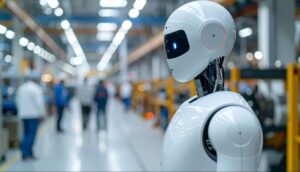
Today, robots can see, learn, make decisions, and work alongside humans, transforming industries at a pace we’ve never seen before. This convergence is known as AI-Powered Robotics, and it’s rapidly becoming one of the most influential technologies shaping the future.
What Makes Robotics Smart?
Traditional robots rely on programmed commands, but AI-enhanced robots use:
-
- Machine Learning
-
- Computer Vision
-
- Natural Language Processing
-
- Reinforcement Learning
-
- Autonomous Motion Planning
This allows them to observe, adapt, and improve — similar to how humans learn.
Instead of simply acting — AI-powered robots can understand their environment and make real-time decisions.
Types of AI-Powered Robots Reshaping the World
 1. Industrial Robots
Used in factories for:
-
- Assembly
-
- Welding
-
- Packaging
-
- Materials handling
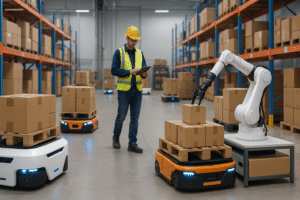
With AI, these robots can detect errors, optimize speed, and collaborate with human workers rather than replace them.
These robots are now known as Cobots (Collaborative Robots).
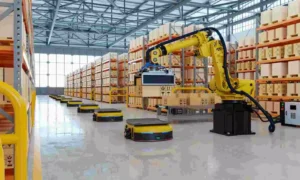
2. Autonomous Mobile Robots (AMRs)
These robots can:
-
- Navigate without tracks
-
- Detect obstacles
-
- Reroute in real time
They’re used in warehouses, hospitals, airports, and retail logistics.
Think: Amazon’s robots moving thousands of orders every minute.
3. Service and Personal Robotics
Examples:
-
- Cleaning robots
-
- Healthcare assistant robots
-
- Delivery and food-serving robots
Modern versions can speak, understand emotions, and adapt based on usage patterns.
4. Humanoid Robots
Humanoid robots are evolving fast — capable of:
-
- Walking
-
- Carrying objects
-
- Interacting socially
-
- Performing skilled tasks
Companies are now working toward commercial human-like robotic assistants powered by AI reasoning models.
Real-World Use Cases Changing Industries
| Industry | How AI Robotics Is Used |
|---|---|
| Manufacturing | Fully automated assembly, inspection, predictive maintenance |
| Healthcare | Surgical robots, patient assistance, medical delivery |
| Agriculture | Autonomous harvesting, crop monitoring, soil analysis |
| Retail & Logistics | Warehouse robots, autonomous delivery, product sorting |
| Construction | 3D printing robots, site mapping, autonomous machinery |
| Hospitality | AI chefs, room service robots, automated check-in systems |
AI-powered automation is no longer a future prediction — it’s happening right now.
Why AI-Powered Automation Is Exploding in Popularity
 Faster Workflows
Robots can operate 24/7 with near-perfect precision.
 Lower Costs
Companies save money by reducing repetitive labor and minimizing mistakes.
 Productivity Boost
A human-robot hybrid workforce achieves more than either alone.
 Human Collaboration
Cobots are designed to be safe and work next to humans — not behind cages.
The Biggest Challenges Ahead
Like all breakthrough tech, AI robotics faces challenges:
-
- Safety risks in human environments
-
- High development and deployment costs
-
- Ethical concerns around job replacement
-
- Cybersecurity risks if robots are hacked
-
- Regulation gaps as technology grows faster than policies
These challenges require thoughtful planning — not fear.
Will AI Robots Replace Jobs?
Some roles — especially repetitive manual tasks — will be automated.
But history shows innovation creates new opportunities:
-
- Robot maintenance
-
- AI workflow design
-
- Robotics programming
-
- Automation quality assurance
-
- Human-robot operations management
Instead of replacing humans, AI robots will shift humans into more meaningful, creative, and high-skill work.
The Future of Robotics: Autonomous, Adaptive, and Everywhere
The next decade will bring:
 Personal assistant robots Fully automated smart factories AI-powered robots in homes, schools, hospitals, and public spaces Autonomous fleets that build, deliver, repair, and manage infrastructure
We are moving from a world where robots follow orders to a world where robots can understand purpose and act intelligently.
Final Thoughts
AI-powered robotics is not just another tech trend — it’s an evolution in how the world works.
We are entering a future where:
 Robots handle the repetitive
 AI handles the complex
 Humans focus on creativity, strategy, and innovation
Automation isn’t replacing humanity — it’s amplifying human capability.
And those who understand and adapt to this change will lead the industries of tomorrow.